

Which Part Of The Nephron Filters Blood From The Circular System Into The Renal Tubules
Beefcake of the Urinary System
How does the urinary system piece of work?
The urinary arrangement's function is to filter claret and create urine equally a waste by-product. The organs of the urinary system include the kidneys, renal pelvis, ureters, bladder and urethra.
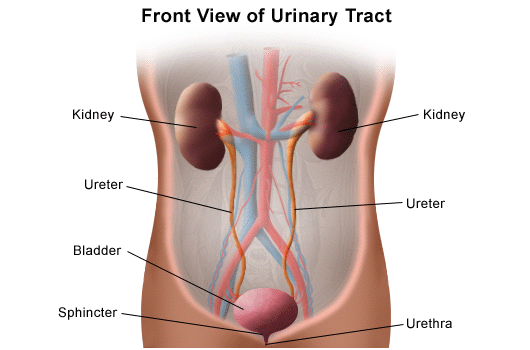
The body takes nutrients from food and converts them to energy. After the torso has taken the food components that it needs, waste products are left behind in the bowel and in the blood.
The kidney and urinary systems help the body to eliminate liquid waste called urea, and to keep chemicals, such equally potassium and sodium, and water in balance. Urea is produced when foods containing protein, such equally meat, poultry, and sure vegetables, are broken downwards in the body. Urea is carried in the bloodstream to the kidneys, where it is removed along with h2o and other wastes in the grade of urine.
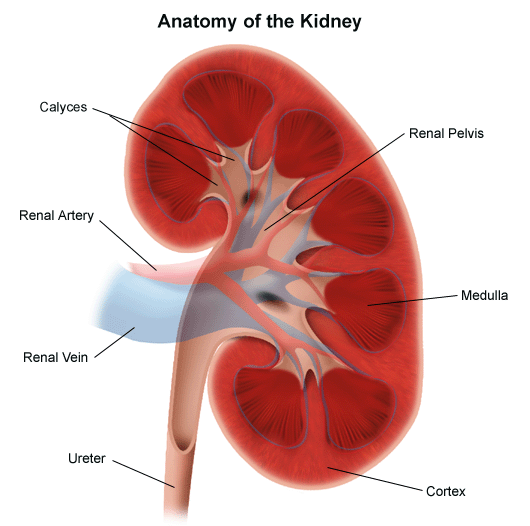
Other important functions of the kidneys include blood pressure regulation and the product of erythropoietin, which controls carmine blood cell production in the bone marrow. Kidneys also regulate the acid-base residual and conserve fluids.
Kidney and urinary organization parts and their functions
-
Ii kidneys.This pair of purplish-brown organs is located below the ribs toward the center of the back. Their function is to:
-
Remove waste products and drugs from the torso
-
Balance the torso's fluids
-
Release hormones to regulate blood force per unit area
-
Control production of ruby-red blood cells
-
The kidneys remove urea from the blood through tiny filtering units called nephrons. Each nephron consists of a ball formed of pocket-size blood capillaries, called a glomerulus, and a minor tube called a renal tubule. Urea, together with h2o and other waste product substances, forms the urine as it passes through the nephrons and down the renal tubules of the kidney.
-
Two ureters.These narrow tubes carry urine from the kidneys to the bladder. Muscles in the ureter walls continually tighten and relax forcing urine down, away from the kidneys. If urine backs up, or is immune to stand still, a kidney infection tin can develop. Most every 10 to 15 seconds, small amounts of urine are emptied into the bladder from the ureters.
-
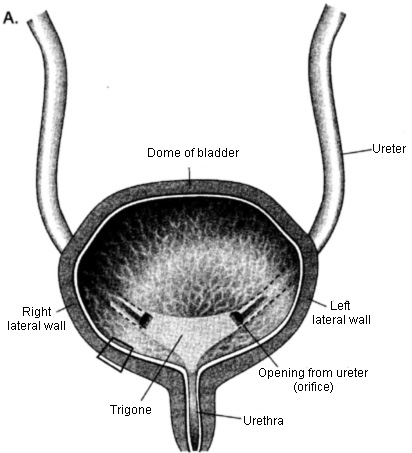
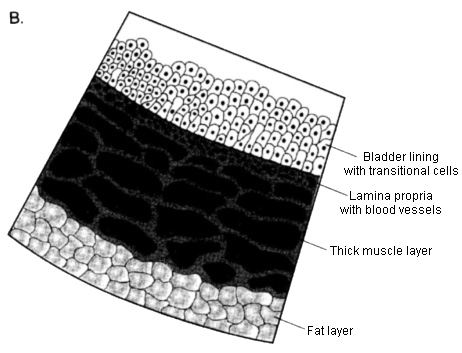
Bladder.This triangle-shaped, hollow organ is located in the lower abdomen. It is held in place by ligaments that are attached to other organs and the pelvic bones. The float's walls relax and expand to store urine, and contract and flatten to empty urine through the urethra. The typical salubrious adult bladder tin can store upwardly to ii cups of urine for two to v hours.
Upon examination, specific "landmarks" are used to draw the location of whatever irregularities in the float. These are:
-
Trigone: a triangle-shaped region near the junction of the urethra and the bladder
-
Right and left lateral walls: walls on either side of the trigone
-
Posterior wall: back wall
-
Dome: roof of the bladder
-
-
2 sphincter muscles.These circular muscles assistance keep urine from leaking by endmost tightly like a condom band effectually the opening of the bladder.
-
Nerves in the bladder.The fretfulness alert a person when it is fourth dimension to urinate, or empty the bladder.
-
Urethra.This tube allows urine to laissez passer outside the body. The brain signals the bladder muscles to tighten, which squeezes urine out of the bladder. At the same time, the brain signals the sphincter muscles to relax to let urine get out the bladder through the urethra. When all the signals occur in the correct order, normal urination occurs.
Facts about urine
-
Normal, healthy urine is a pale harbinger or transparent yellow colour.
-
Darker yellow or honey colored urine means you need more than water.
-
A darker, brownish colour may point a liver problem or severe aridity.
-
Pinkish or cerise urine may mean blood in the urine.

Which Part Of The Nephron Filters Blood From The Circular System Into The Renal Tubules,
Source: https://www.hopkinsmedicine.org/health/wellness-and-prevention/anatomy-of-the-urinary-system
Posted by: rosariocreter.blogspot.com
0 Response to "Which Part Of The Nephron Filters Blood From The Circular System Into The Renal Tubules"
Post a Comment