

How Glaciers Form From Snow Compressed Into Ice Animation
Snowfall
How practise we build a glacier? We showtime with a snowflake. Snow, over time, is compressed into firn, and then into glacier ice.
Snow falls in common cold regions, such as mount tops or in polar regions. In glaciology, snow refers to material that has not changed since it roughshod1.
Snow is very light and fluffy, and has a very depression density. If the snow is wetter, it will have an increased density. Snowflakes accept a hexagonal structure, and fallen snow has a significant amount of air in it.

Firn
Firn is usually defined as snow that is at to the lowest degree one year old and has therefore survived ane melt season, without beingness transformed to glacier ice.
Firn is transformed gradually to glacier water ice equally density increases with depth, as older snow is buried by newer snow falling on top of it. Year later on yr, successive accumulation layers are built up. In the accumulation zone of a glacier, density therefore increases with depth; the rate depends on the local climate and rate of accumulation1. Firn transforms to glacier ice at a density of 830 kg m-iii.
| New snowfall (immediately after falling, calm conditions | 50-lxx |
| Damp new snowfall | 100-200 |
| Settled snowfall | 200-300 |
| Air current-packed snow | 350-400 |
| Firn | 400-830 |
| Very wet snow and firn | 700-800 |
| Glacier ice | 830-923 |
Firn transforms to glacier ice in 3-5 years in the temperate Upper Seward Glacier in the St Elias Mountains near the Alaska-Yukon border. Firn becomes ice at a depth of virtually 13 mi. At sites similar this with rapid snow aggregating, the depth of a firn layer, and the load on it, increases rapidly with depth.
However, in cold, dry Eastward Antarctica, firn becomes ice at a depth of 64 m at Byrd and 95 m at Vostok. 280 years are needed at Byrd, and 2500 at Vostok. Low temperatures tedious the transformation. Temperatures at Vostok, the coldest region of Earth, are 30°C lower than Byrd, which explains the slower increase in density. In addition, slow accumulation gives slow burial, and a small load each year; the increase in density takes much longer.
Typically, the transformation of firn to ice takes 100-300 years, and a depth of fifty – 80 ki.
Glacier ice
Firn becomes glacier water ice when the interconnecting air or h2o-filled passageways betwixt the grains are sealed off ("pore closure")1. Air is isolated in dissever bubbles. This occurs at a density of 830 kg m-iii. The air space between particles is reduced, bonds form between them, and the particles grow larger. This is a process known as sintering. Increasing pressure compresses the bubbles, placing the enclosed air nether pressure and increasing the density of the water ice2.
Fresh snowflakes, which have a complex shape, take a big surface surface area. Over time and under pressure, the surface expanse is reduced, the surface is smoothed, and the total surface area is reduced. Fresh, complex snowflakes are transformed into rounded particles.
The transformation of firn to ice is much faster where there is melting and refreezing2. Meltwater can percolate downwards, infilling porespaces, and the displaced air escapes up. If the snow is nether 0°C, the water will freeze, producing areas of meaty water ice. This will produce high density ice much more apace than in colder regions without melting.
The density of pure glacier ice is usually taken as 917 kg thou-three. This strictly is only true at 0°C and in the upper layers of water ice sheets and mountain glaciers; the density may exist greater at the mid-depth ranges in polar ice sheets, where there are no bubbles and temperatures are -xx°C to -xl°C1.
Below 4 km of ice, such equally at the centre of the East Antarctic Ice Canvas, the pressure level would increase the density to 921 kg yard-three.
Bubbles
Bubbling are common in glacier water ice. Bubbles can contain liquid water or atmospheric gases, making them very useful for water ice cadre research. The air in the bubble largely reflects the atmospheric concentrations when the ice formedane. In polar environments, bubbles in the ice occupy near ten% of the volume when firn turns to water ice.
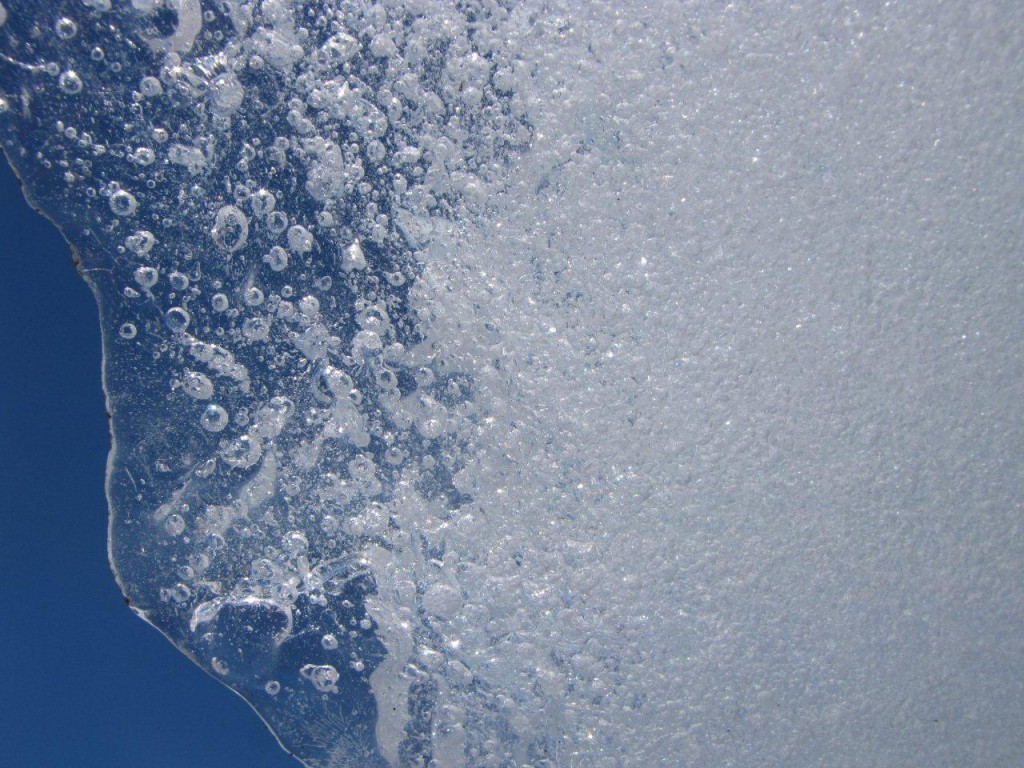
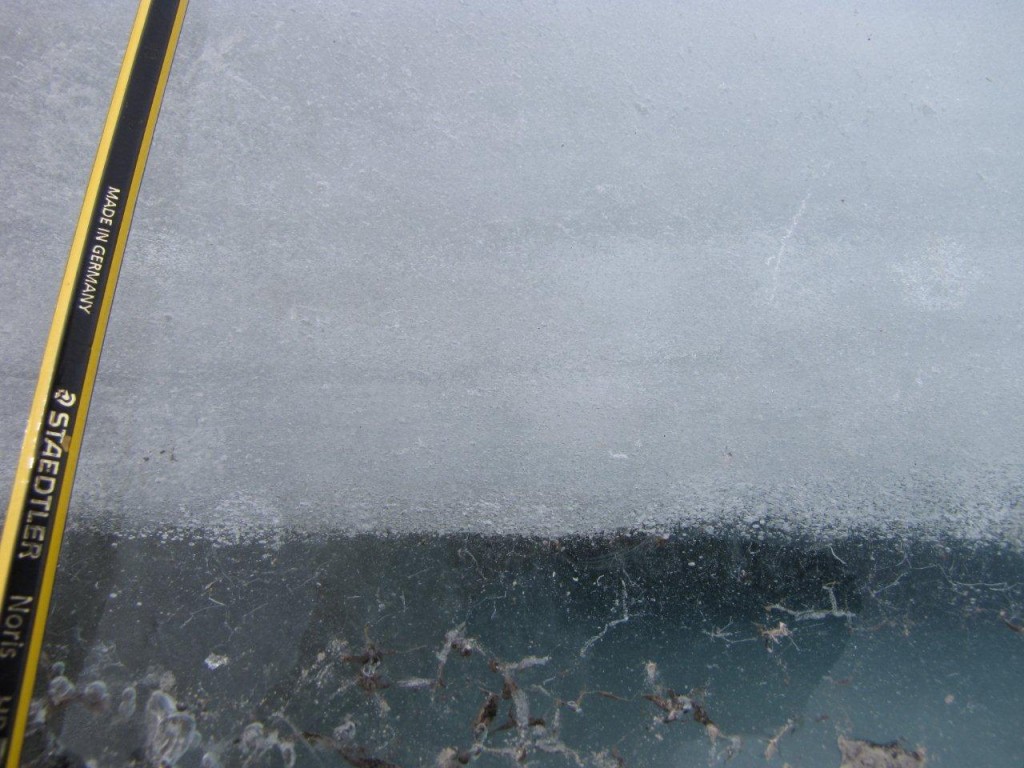
With greater depth in polar water ice sheets, bubbles compress as the overlying water ice increases. The gas pressure within the bubbling therefore increases, and at certain depths, the gas attains a dissociation pressure. The bubbles begin to disappear every bit the gas molecules form clathrate hydrates 1. This procedure takes thousands of years.
Droppings
Glacier ice contains diverse impurities in tiny amounts. Past about scales, glacier ice is a very pure solid-world textile, because the processes leading to snow on a glacier – evaporation, condensation, precipitation – act as a natural distillation system1.
Notwithstanding, glaciers tin contain impurities. The dirtiest glaciers are mountain glaciers, where debris tin can autumn straight onto the ice surface. On ice sheets and glaciers, grit and other droppings may blow onto the ice surface.

Debris on the water ice surface can affect the assimilation of energy at the ice surface, and lead to increased or decreased melting.

Layers in the ice
Glaciers are composed of sedimentary layers in their accumulation zones, formed of annual layers of snowfall. These layers are initially parallel to the glacier surface. This is the primary stratification in structural glaciology.
In temperate and subpolar settings, the annual sedimentary layers consist of alternating thick layers of bubble-rich ice, which originated every bit winter snow, and thin layers of clear ice, which are the refrozen meltwater from the summer melt season.


Debris horizons may course, when summer melting concentrates droppings (such equally rockfall and wind-blown dust) on the ice surface.
In common cold polar regions, annual layering forms instead by seasonal variation of snowfall metamorphism and wind deposition1.

Blue glacier ice
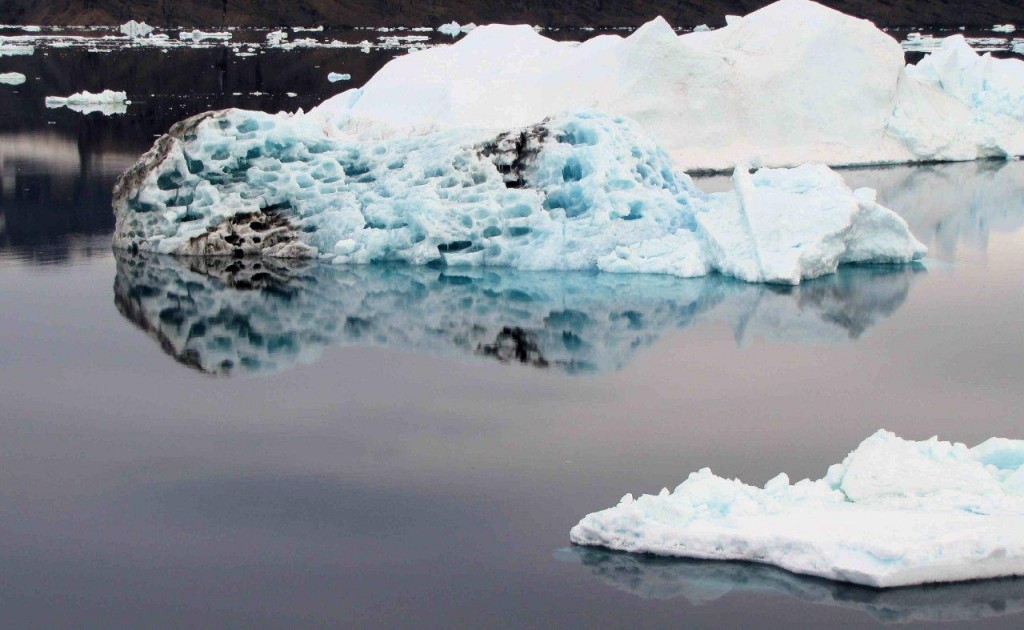
Glacier water ice is blue because the longer visible wavelengths are absorbed. The more energetic, blue, wavelengths are scattered dorsumtwo. The effect is greatest with deep, basal water ice, which is chimera costless and has large crystals. The blue colour tends therefore to be virtually intense in the calls of calved icebergs or fresh fractures.
Rough, weathered ice and fresh snow will appear white because preferential assimilation does not occur.
Further reading
- GlaciersOnline: Firn, basal water ice, superimposed ice, accumulation
- NSIDC: How are glaciers formed?
- Geology.com: Glaciers
Source: https://www.antarcticglaciers.org/glacier-processes/from-snow-to-glacier-ice/
Posted by: rosariocreter.blogspot.com
0 Response to "How Glaciers Form From Snow Compressed Into Ice Animation"
Post a Comment