

Which Of The Following Is Considered The Simplest Animals
On a sunny pre-pandemic afternoon at the beach near Santa Cruz, California, children shriek as the waves demolish their sand castles, and seagulls squawk over a discarded bag of salt-and-vinegar potato chips. Pelicans, sea lions, and fishermen flock to the stop of an old wooden pier, attracted by schools of fish that shelter in the wreckage of a one-half-submerged tanker, the SS Palo Alto. The pier bristles with angling poles, their long lines trailing into the water.
At the end of one of these lines, I promise, dangles an elusive, mysterious brute—not a fish, merely the world'south simplest animal, Trichoplax adhaerens. Named after the Greek words for "hairy, sticky plate," Trichoplax belongs to ane of the about ancient animal lineages on Earth, a phylum known as Placozoa that is more than than 650 meg years former.
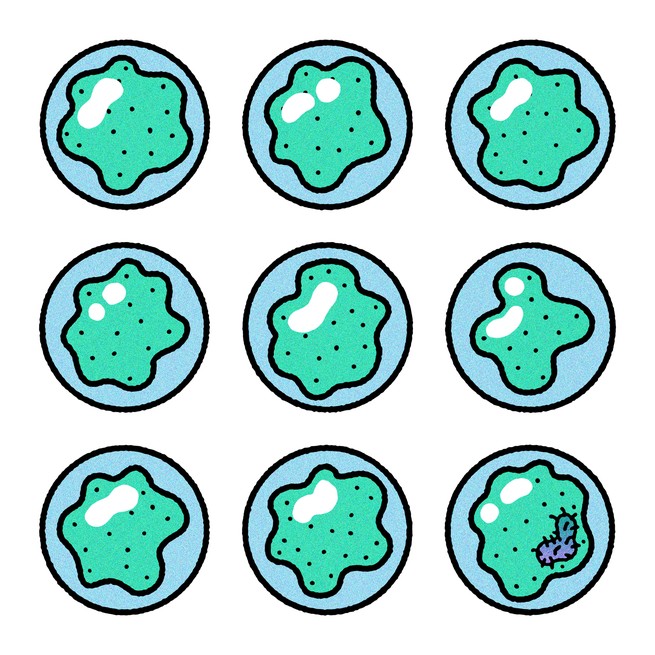
Trichoplax lacks nearly all the usual animal characteristics: It has no muscles, no tum, and no neurons. Its minute, translucent body consists of just ii layers of cells, surrounding a gooey, gristly middle, and under a microscope information technology looks similar a deflated beach ball covered in hair. Yet this shapeless, brainless animal tin do remarkable things, including hunt for algae and defend itself with venom. Its homo fans think the species is a budding scientific superstar, conveying clues to the origins of multicellular animals, brains, and cancer.
The way to trap a wild Trichoplax, according to experts, is to place glass microscope slides in a plastic rack that will hold them securely, only spaced far enough apart to allow seawater to menses through. Tether the case to a piece of fishing line, dangle information technology over the side of a pier or dock to a depth of at to the lowest degree a meter, and let it hang there for a week or two. If you are lucky, a Trichoplax will float into the case, stick to the glass, and start to clone itself.
Manu Prakash, the biophysicist I'm meeting on the pier, has not been very lucky lately. Although he captured one Trichoplax in Puerto Rico in 2018, it died before he could go it abode to the lab, and he hasn't caught one off the California coast in a year.
Prakash is forty, with dark chocolate-brown curls and the concave, gorging posture of someone who has been peering through microscopes since he was in elementary school—when he built his first scope, from a pair of his brother's eyeglasses. "My brother was not happy," he says. Prakash is a prolific inventor of scientific tools, and his creations often draw inspiration from toys and animals: His miniature chemical science lab has a mitt-cranked wheel and tiny dial holes like a music box, and his paper centrifuge is based on a child's whirligig. He is best known for an invention chosen the Foldscope, a $1 origami microscope that can be folded out of a sheet of newspaper embedded with micro-optics. He first became interested in Trichoplax when he decided to build a much bigger, more powerful microscope that could image every cell within a freely moving animal.
Trichoplax's simple torso should have fabricated an platonic study subject. But for a long time, none of the scopes he built could capture it: The animate being kept wriggling out of view or off the slide. Prakash spent seven years building a microscope that could record Trichoplax in motion, at upwardly to a one thousand thousand frames per second. One time the microscope was built, he and his team were able to watch as the organism moved in means that had never been observed in other animals. Prakash was fascinated by Trichoplax'south seemingly infinite capacity to stretch and contract, like gluey dough betwixt a toddler's fingers. He wondered if its ability to tear itself autonomously and heal within seconds—"like Flubber," he says—could inform the development of new materials that repair themselves and cocky-assemble.
Prakash studies a strain of Trichoplax clones descended from a population cultivated in Germany. But these domesticated animals don't comport similar the wild ones, and, most importantly, they won't take sex in captivity. Until scientists tin can find sexually reproducing adults in the wild, or somehow coax them into having sex in the lab, there's no way to discover their total life cycle, which could hold clues to how their elementary bodies evolved, says Carolyn Smith, a neuroscientist at the National Plant of Neurological Disorders and Stroke: "We're in a real pickle." Tantalized by the prospect of finding previously unknown larval forms or metamorphic stages, embryos, and egg sacs, Prakash has traveled all over the world to collect Trichoplax from the shallow tropical seas where it typically dwells.
The chances of finding a Trichoplax in the frigid waters of Santa Cruz, already slim, seem even slimmer when my phone pings with a text. Prakash, who is battling a cold, is stuck in San Francisco traffic. An hour later, I receive some other bulletin: Prakash and the 2 lab members who volition bring together our search have gotten lost, and gone to the wrong embankment. When Prakash finally arrives, he's wearing a stake-blue T-shirt that says Experiment, Learn, Fail, Repeat, and carrying a modest Igloo libation for transporting the animals. But when we get to the end of the pier, he can't notice the trap that one of his graduate students set up out a couple of weeks ago.
Grace Zhong, a graduate student in Prakash's lab who is studying how Trichoplax senses its surround, texts her lab mate to ask for directions. Eventually, they locate the spot, but the trap is gone. As a set of waves rolls in, making the old pier creak, Prakash speculates that the line holding the trap must have been snapped in the surf, or cleaved off by bounding main lions. He predicts that we'll accept improve luck with the traps in the Monterey Bay marina, which is more sheltered. I'm skeptical—by the time we make it in Monterey, an 60 minutes's drive s, it will be shut to sunset. As I'll before long acquire, however, Prakash is non easily deterred on the trail of wild Trichoplax. To him, the search for the world's simplest beast is no casual field trip, no mere holiday outing, just a quest.
Although he's one of the youngest scientists to autumn for Trichoplax, Prakash is far from the first. The weakness for the amoeba-like beast often begins unexpectedly, when it squirms into a researcher's field of view. The German language zoologist Franz Eilhard Schulze, who discovered the animal, spotted it as it crept along the interior of a saltwater aquarium meant for other species. Smith saw her first Trichoplax when it glided across her microscope slide while she was examining some sea sponges.
In the tardily 1800s, when Schulze discovered Trichoplax, biologists were arguing about the origins of the animal kingdom. Inspired by Schulze'southward find, the High german zoologist Otto Bütschli speculated that the mutual ancestor of all animals was, like Trichoplax, a pancake-shaped fauna with no digestive arrangement that crawled along the seafloor grazing on algae. But another 19th-century biologist, Ernst Haeckel, had a different idea. Based on an organism he'd found while studying sponges off the coast of Norway—a tiny sphere of cells covered in whiplike tails that he called Magosphaera planula, or "wizard's ball"—Haeckel idea that the commencement multicellular animal did not crawl but swam, filtering nutrient from seawater.
Haeckel'southward hypothesis overshadowed Bütschli'south, likely because Haeckel was the more famous and flamboyant of the two scientists, says Vicki Pearse, a retired marine biologist and i of the earth's foremost Trichoplax experts. Information technology besides didn't help that scientists couldn't hold on what kind of animal Trichoplax was, she notes. When the embryologist Charles Sedgwick Minot wrote about Schulze'southward find in Scientific discipline, in 1883, he described Trichoplax as "an animal quite unlike from any affair hitherto known," which "bears a strong resemblance to a sponge larva." Dismissed equally an immature sponge or jellyfish, Trichoplax roughshod into scientific obscurity until the zoologist Karl Grell constitute the animals in some seaweed he'd nerveless at the northernmost tip of the Red Sea. Grell cultivated the clonal strain of T. adhaerens that most researchers at present grow in their labs, and studied it carefully under an electron microscope. He concluded that it belonged in its own distinct phylum within the animal kingdom, which he named Placozoa, meaning "flat animals." At the time, scientists believed that T. adhaerens was the merely living placozoan, but they have since uncovered a good deal more than genetic diverseness within the phylum. (A new genus includes the species Hoilungia hongkongenis, named after a shape-shifting dragon rex in Chinese mythology.)
Although in that location's nevertheless a fair amount of uncertainty about how the primeval animals are related to each other, recent genomic-sequencing studies suggest that placozoans were not the mutual ancestor to all living animals, and that either sponges or comb jellies came showtime, David Gilt, a paleobiologist at UC Davis, says. Although Trichoplax comes from an older lineage than most animal groups live today, "there are a few groups that appear to be older," he notes.
Even if placozoans are not the oldest animals, they're still some of the weirdest. Trichoplax's genome, published in 2008, contained a surprising twist, Athula Wikramayake, a developmental biologist at the Academy of Miami, says. Despite having the simplest bodies of all animals, placozoans carry many of the aforementioned genes equally humans exercise, including numerous genes involved in edifice brains and other circuitous organs, like those in the digestive organization. Placozoans comprise far more than genetic complication than scientists ever guessed, Wikramayake says. "The question is, what are they doing with it?"
I possibility is that Trichoplax used to have circuitous features like neurons, but lost them. Although it's intuitive to remember that unproblematic animals e'er evolve into more complicated ones, "lots of [animal] groups have become simpler over time," Gilt says. Some parasitic worms, for case, have given up complex stomachs and eyes because they no longer demand them: They get all their nutrition from their hosts. Mark Martindale, a marine biologist at the University of Florida, suspects that Trichoplax may have followed a similar evolutionary route. The lab-grown animals may just be larval placozoans, while sexually reproducing adults exist equally parasites in the bodies of marine organisms—mayhap in a fish's kidney, he says. A simpler explanation, according to Vicki Pearse and other scientists, is that genes that encode neurotransmitter-like molecules in Trichoplax evolved to produce nervous systems in after animals.
Idue north Prakash'south lab, located in the leafy bioengineering quad at Stanford University, he and his graduate students, postdocs, and lab technicians are less concerned with figuring out where Trichoplax fits into the story of animal evolution than how information technology manages to live such a full life—creeping along the sea floor, sensing its surroundings, eating algae—with such minimal equipment. "Where does behavior come from in a organization that doesn't have neurons?" he asks. He's also interested in the shape-shifting animal'south basic concrete properties: "Is information technology a liquid? Is it a solid? Is it something in the middle?"
Ane thing Trichoplax cannot practise, Prakash recently discovered, is swim. Some scientists say it tin swim—including Pearse, who says she'due south seen it. Others say it can't. In a nod to the swimmer-versus-crawler debate of the 19th century, Prakash decided to give Trichoplax a swim examination.
The exam took place in i of Prakash's contempo inventions, a Ferris bike–inspired contraption he calls the Gravity Auto. Composed of a sparse plastic wheel total of water, the Gravity Machine rotates vertically in forepart of a powerful microscope, acting equally an aquatic treadmill for microorganisms. Fifty-fifty in the narrow deejay, which is less than half an inch wide, Trichoplax is so small that finding information technology with the naked eye is like searching for a dust mote in a gymnasium.
"That's it!" Prakash said, as a translucent speck flew beyond the microscope's computer screen. "That'due south merely dust," objected the doctoral pupil Deepak Krishnamurthy, who helped invent the contraption. "That's it! Zoom in!" Prakash said again. It was some other piece of clay. Minutes passed, then, "Lock, lock, lock!" This time, the speck was Trichoplax. As it drifted, the animate being seemed to be flailing. It folded and shape-shifted, resembling a taco, then a dumbbell, then a bicycle seat.
"Information technology's falling," Krishnamurthy said.
"Poor Trichoplax. It doesn't know how to swim," Prakash said. "This is going to exist the shortest newspaper ever."
Like Trichoplax, Prakash and his xv to 20 graduate students, postdocs, and lab technicians seem to move in a thousand directions at one time. I day I watched every bit Prakash taught a new doctoral student, Hannah Rosen, how to suction Trichoplax out of a petri dish full of seawater and settle them on a slide. Movement too slowly, and the animal will attach itself stubbornly to the syringe, Prakash explained, his hand darting toward the slide with the speed and precision of a heron's beak. To forbid Trichoplax from creeping off the slides, Prakash has built a small well out of double-sided tape, which he calls a jail. "For the kickoff 30 designs we made, it figured out how to pause out of the jail," he said, with obvious fondness. "Information technology can skid under even the tiniest of gaps. Information technology'due south quite remarkable."
Under low magnification, the Trichoplax looked similar a miniature piece of work by Jackson Pollock— splatters of paint, frozen mid-sling. Equally Rosen zoomed in, however, an animal flowed across my field of vision, apace propelled by its scintillating ciliary fringe. It morphed before my eyes, transforming from something that resembled Commonwealth of australia into a ghostly, yawning caput. As Rosen zoomed in further, the cells seemed to exist simultaneously flowing as one, like a spilled milk shake running downhill, so jostling up against one some other, like thousands of people rushing out of a stadium. Rosen and I stared at the animal, transfixed. "This is as chaotic as life can go," Rosen said. For a moment I envied Trichoplax and its brainless, shapeless catamenia.
From the perspective of an evolutionary biologist, Trichoplax lies on the cusp between unicellular and multicellular animals—a turning signal when unmarried-celled, sperm-like organisms banded together as unified animals. To physicists like Vivek Prakash (no relation to Manu), who worked on Trichoplax in Manu'due south lab at Stanford and recently started his own lab at the University of Miami, the brute is an example of "active matter"—a system that has no cardinal authority only notwithstanding maintains its coherence. Examples of agile thing can be found everywhere in nature, including the acrobatic maneuvers of flocks of starlings, and the shimmering bait assurance formed past schools of fish. Life itself depends on leaderless coordination, starting with the exquisitely choreographed balance of physical forces required to sculpt tissues in a developing embryo.
Trichoplax is a single animal whose cells deport like a flock—merely only up to a point, Manu Prakash and his colleagues accept found. Working together, Trichoplax'southward beating cilia can drive the animal toward food and abroad from danger. Just the cilia are only loosely coordinated. When they beat in opposite directions, the fauna stretches, sometimes splitting into two or iii separate clones. Sometimes the cilia will create a minor fracture that widens into a hole, forming a donut shape that then breaks open into a long, skinny cord.
By analyzing hundreds of hours of video of Trichoplax in motion, Prakash and his team are now working to quantify merely how big the fauna tin can go earlier the cilia tear it apart like rebellious armies. They're also trying to figure out how Trichoplax's thin tissues remain intact, even every bit the cilia pull its body in opposite directions. I clue comes from the waves of cellular shrinkage and expansion—faster than any observed in other animals—that allow the animal'south tissue to switch apace from soft to stiff in gild to absorb physical stress.
In the computer simulations that the Stanford lab has built based on Trichoplax's body and move, Prakash and his team have begun to tweak aspects of the beast'south biology to create new properties that don't be in nature. When the team virtually strengthens the protein bonds between Trichoplax's cells in a reckoner model, for example, the resulting animal is stiffer and displays new patterns of move. For Prakash, Trichoplax is a kind of primordial Play-Doh—a way not just to sympathize animals that exist today but besides to observe synthetic animals and materials that could exist, he says.
Among the many unsolved Trichoplax puzzles, one of the well-nigh mysterious is how the animal's individual cells talk to one another. Smith, the neuroscientist at the National Institutes of Health, wants to know how Trichoplax senses its food, moves toward it, and releases the chemic signals necessary to make its cilia end chirapsia while information technology dumps out digestive enzymes and absorbs nutrients through its bottom layer. In other words, if the thousands of cilia that propel Trichoplax acquit similar a flock, where are their shepherds?
Smith and her colleagues have institute a series of evenly spaced cells along Trichoplax'southward periphery that she thinks may help herd the cilia by secreting a chemical signal that makes them pause. The chemicals are similar to the neurotransmitters that regulate appetite and contractions of the digestive tract in humans, according to the neurobiologist Diego Bohórquez, of Knuckles Academy. When many animals are grouped together, a single Trichoplax releasing the chemical can trigger its neighbors to secrete also, causing the whole group to slow down and graze on algae "much like bison on a grassy plain in Yellowstone," Borhórquez wrote in a 2018 commodity in the scientific journal Encephalon Inquiry.
There's much more than to learn about Trichoplax's movements, even so, Smith notes. The molecules that cause the animal's cilia to pause work far also slowly to control Trichoplax's fastest movements, she says. "If you watch movies of the brute gliding on its cilia, you see that the animate being tin change directions really rapidly, within seconds or less than seconds."
Ultimately, Prakash hopes to sympathize how Trichoplax can survive the violent forces of its own mutinous trunk—as well as harsh environments like the rugged California coast, where a six-foot moving ridge tin pummel tiny ocean creatures with the force that a 1,000-mph wind would accept on a human beingness.
Westwardhen Prakash and his team accomplish Monterey, a red tide caused past billions of plankton has turned the water so dark that information technology looks similar obsidian. Crouching in the sheltered harbor of the Monterey marina beside a sailboat christened Diablito, Prakash slides his arm elbow deep into the water and draws upward a length of fishing line. This time, the trap is intact.
Prakash easily it to staff scientist Hazel Soto Montoya, who puts information technology in the Igloo libation with reddish seawater she has filled at the marina. Soto Montoya is currently studying the symbiotic bacteria that live in Trichoplax's body, and so she wants to re-create the ecological milieu in which they establish information technology, cherry-red tide and all.
Adjacent, we bulldoze to the Hopkins Marine Station, a venerable Stanford lab assail a cypress-ringed outcrop of rocks jutting into the Pacific Ocean. It's nearly dark, but Prakash decides that the team should search the tide pools surrounding the station for shine, flat rocks or shells where Trichoplax may lurk unseen. Rolling up the cuffs on our pants and donning waterproof shoes, we tiptoe over pale-light-green ocean anemones and crowded colonies of indigo mussel shells. As the sun sets, turning the tide pools violet, Prakash holds upwardly a rock and turns it over in his hand. "Information technology is impossible to discover them, because there are literally infinite places they could be," he muses.
Some scientists believe that Trichoplax, with its stripped-downwards body plan and easy-to-manipulate genome, could be a useful model organism for medical researchers. Information technology's especially intriguing because it breaks the rules that almost lab animals follow: Unlike mice or fruit flies, Trichoplax has an indefinite life bridge, rapidly heals, and never—so far every bit scientists tin can tell—develops cancer. "Nosotros're always trying to figure out what the rules are," says Billie Swalla, a biologist at the University of Washington who studies regeneration in weird animals like acorn worms, which tin regrow their heads. Studying rule breakers like Trichoplax, which can tear themselves apart and heal in minutes, could yield insights into the treatment of human injuries like damaged spinal cords, she says.
While Prakash agrees that the animal holds great promise for biomedical research, his pursuit of Trichoplax is about more than its practical applications. "I also study it for its beauty and elegance," he says.
We explore the tide pools until the sun goes down, so go out to dinner. Just as the repast ends, around nine p.chiliad., does information technology dawn on me that Prakash intends to go back to the lab that night to continue searching for Trichoplax. The team has microscopes fix in one of the Hopkins Marine Station classrooms—a quiet, monastic room well suited to the search for tiny, near-invisible organisms in slide afterwards slide afterwards slide. Later sitting in the harbor for a couple of weeks, each slide is a tangled jungle of biofilms and other organisms, whatever one of which could be concealing a tiny, flat, transparent Trichoplax. A single slide can accept an hour to search, and each of the 3 cases contains twenty slides. It seems like the kind of action that could drive a person crazy, I comment to Zhong and Soto Montoya. Yep, they nod, with beatific smiles.
When the team leaves for the lab, I retreat to my dorm room at the Monterey hostel, defeated. I am not hardcore enough to chase wild Trichoplax, I think. I have a nap. At 11:32 p.m., my phone lights upward. It's a video text showing Zhong and Soto Montoya huddled around the microscope, looking buoyant. Zhong has found a Trichoplax. "That's information technology, 110 percent," Prakash says. "Information technology'southward cute, beautiful!" On a computer screen that shows the display from the microscope, Trichoplax looks like a glowing, pulsing orb surrounded past catholic protoplasm. Soto Montoya finds a second, bigger creature. They sign off and keep scanning each slide, one past i, until 4 a.1000.
Subsequently that morning, I reconvene with the team. Prakash's cold has gotten worse, and Soto Montoya and Zhong are swaying with exhaustion. Withal, they sit down, pull the remaining slides out of the seawater bathroom, and start looking for more animals.
They keep a shut center on the two wild Trichoplax they've plant. "Is it alive? Is it happy?" Zhong asks. Both are live, though their happiness is harder to assess. The squad will have to affluent the seawater regularly and go along it at the right temperature, or bacteria and algae will showtime to overgrow the Trichoplax and kill them, Prakash says. He instructs Soto Montoya and Zhong to draw any organisms they find around the two animals on the classroom blackboard, in order to document the ecosystem. Bit by bit, a chalk menagerie of minute ocean creatures fills the blackboard. To identify the microorganisms, Prakash refers to a famous textbook on marine invertebrates, Animals Without Backbones, which was co-written past Vicki Pearse and her hubby, John, some other famous marine biologist. (The couple live down the street from the Hopkins lab.) The brute names sound like pasta: vorticellids, spirobids. 1 of the drawings looks, to my exhausted brain, similar a martini olive with cat whiskers.
Slumber deprived and sniffling, but withal adamant to make the almost of the squad'south last hours in Monterey, Prakash decides to immerse more than traps at an abalone farm in the harbor. To access the farm, we climb downwardly a cold, wet ladder into the nighttime shadow of the dock, and stand amidst glace piles of drying salt-encrusted kelp.
Sea lions lounge on the pylons effectually us, barking and farting. Prakash places the traps within the abalone cages, where they will exist protected from waves and curious body of water lions, and uses thick ropes to lower the cages into the water. The tranquility, deep water seems like the perfect place to catch more Trichoplax. Soon, Prakash and his students will exist back to detect out if information technology is.
Source: https://www.theatlantic.com/science/archive/2020/06/tracking-one-worlds-first-animals/612091/
Posted by: rosariocreter.blogspot.com
0 Response to "Which Of The Following Is Considered The Simplest Animals"
Post a Comment